
Face in the Rock: How Firefighters in Kazakhstan Stumbled into Prehistory
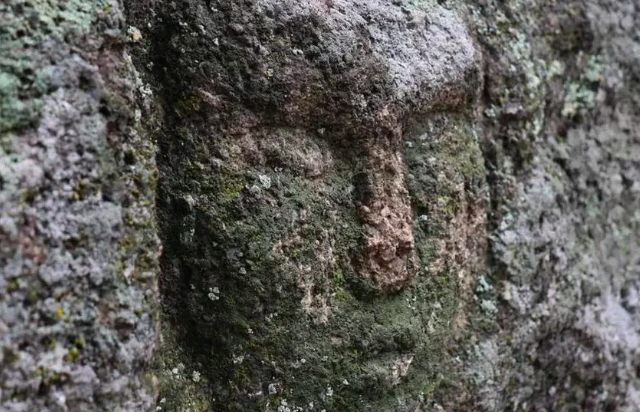
Two firefighters on a routine patrol in the Sandyktau region discovered a carved face in a large granite boulder. Roughly 10.5 × 8 inches, the face has prominent eyes, a long nose, full lips... archaeologists believe it might be part of an ancient ritual complex, though its exact culture and age are still under investigation.
WORLD NEWSCULTUREFEATURED
A Strange Find on a Routine Patrol
It was a Tuesday, and two firefighters in Kazakhstan’s Sandyktau district expected little more than the usual: checking equipment, scanning fields for brush fires, maybe chasing off kids lighting cigarettes in the wrong place. Instead, their flashlight beams caught something peculiar: a large granite boulder with a human face staring back at them.
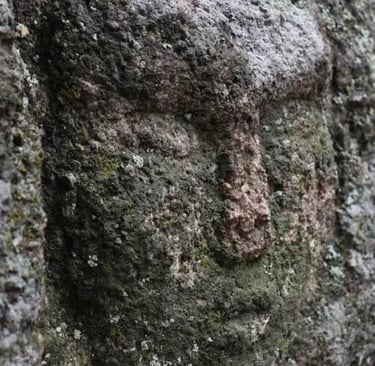
The carving wasn’t new — it had been waiting there for centuries, hidden in plain sight. But to the firefighters, who stumbled across it by accident, it felt like stepping into a scene from an Indiana Jones movie. Eyes deeply set, a long nose, lips thick and solemn, the stone face measured about 10 inches across. It wasn’t just a trick of the light. It was art.
They radioed in the discovery. Archaeologists soon descended on the site, buzzing with questions: Who carved this? Why here? And why hadn’t anyone noticed before?
A Land Layered with History
Kazakhstan doesn’t always make global headlines, but archaeologists know it as one of the richest cultural crossroads on Earth. Steppe nomads roamed here for millennia, leaving behind burial mounds, stone steles, petroglyphs, and mysterious structures older than the pyramids. Every few years, shepherds, construction crews, or farmers stumble on something that rewrites history books.
The Sandyktau find is part of that tradition. Granite outcrops dot the steppes, often used as canvases by ancient peoples. The region’s earliest carvings date back to the Bronze Age (roughly 2000–1000 BCE). Many depict animals — horses, camels, deer — but human faces are rarer.
“This isn’t just doodling,” said Dr. Aigul Serik, an archaeologist from Astana State University. “Faces carved in stone carry symbolic weight. They could represent ancestors, spirits, or deities. Finding one out here hints at ritual significance.”
A Closer Look at the Face
Archaeologists measured the carving: about 10.5 inches tall, 8 inches wide. The features are stylized but clear: wide almond eyes, a long nose, full lips. There’s no headdress, no adornment, no background symbols. Just the face, peering out of granite like a prehistoric emoji.
Some experts compare it to Turkic stone “balbals” — gravestones carved with human likenesses, often found across Central Asia from the 6th to 10th centuries CE. Others argue it may be older, perhaps connected to Bronze Age fertility or shamanic rituals.
“There’s a timelessness to it,” said Serik. “It could be 500 years old, or 3,000. The style is so minimal that dating becomes guesswork.”
Firefighters as Archaeologists
The irony isn’t lost on locals: two men trained to fight fires, not dig through history, may have stumbled on one of the year’s biggest archaeological finds.
“It happens more often than you’d think,” said Serik. “Farmers, miners, even children have found burial mounds and artifacts here. Kazakhstan is like an open-air museum, but most of it’s hidden until someone literally trips over it.”
For the firefighters, it’s a bragging right. “We didn’t expect to find a face in the rocks,” one told local media. “We just thought it looked strange. Turns out it’s history staring back at us.”
Why Faces Matter
In archaeology, human faces are potent. They suggest identity, spirituality, or a desire to immortalize individuals. In many steppe cultures, stone faces were tied to ancestor worship: carvings placed near burial sites to watch over the dead.
The Sandyktau face might fit that pattern, but researchers caution against easy answers. Kazakhstan has hosted Scythians, Sarmatians, Huns, Turks, Mongols, and countless others. Each culture layered its own art onto the landscape.
“What we see is continuity,” said Serik. “The steppe isn’t empty. It’s full of stories, and each carving is a fragment of a much larger epic.”
Quirky Theories
Of course, the discovery has also sparked more outlandish speculation. Social media in Kazakhstan lit up with theories:
Ancient Aliens: Some insisted the face was extraterrestrial, proof that aliens had left their calling card in Central Asia.
Prank Carving: Others joked it was the work of a bored Soviet geologist in the 1970s.
The World’s First Selfie: A meme circulated claiming the stone face was “prehistoric Instagram.”
Archaeologists roll their eyes at these, but admit the mystery is part of the charm. “We don’t know yet who carved it, so people fill in the blanks,” said Serik. “That’s human nature.”
Archaeology’s Odd Helpers
The firefighter discovery highlights a broader truth: many major finds happen by accident.
In 1991, hikers in the Alps stumbled across Ötzi the Iceman, a 5,000-year-old frozen mummy.
In Britain, a farmer plowing a field uncovered the famous Mildenhall Treasure, a hoard of Roman silver.
In Peru, a group of construction workers found an intact 1,000-year-old tomb while digging a drain.
Firefighters in Kazakhstan now join that unlikely club of “oops, we just found history.”
The Face in Context
For archaeologists, the Sandyktau face is a piece of a puzzle. They’ve already mapped nearby burial mounds and stone alignments, suggesting this area was ritually important. The face may have been carved to mark a sacred site.
More research is needed. Radiocarbon dating isn’t possible on stone, so scientists will look for lichen growth, tool marks, and nearby artifacts. Drone surveys may reveal other carvings hidden on the landscape.
“This could be the first of many,” Serik said. “Often, when you find one carving, you find a whole cluster.”
The Cultural Importance
Kazakhstan has invested heavily in preserving its archaeological heritage. The discovery fits into a national narrative that emphasizes the depth of Central Asian history — beyond the Soviet era, beyond even Genghis Khan.
“This stone face connects people today with those who lived here thousands of years ago,” said Serik. “It reminds us that identity, art, and memory are universal. Across cultures, across millennia, we carve faces because we want to be remembered.”
A Face for the Future
For now, the Sandyktau stone face sits quietly, half-hidden in the steppe, guarded not by archaeologists but by the same granite boulder that held it for centuries. Tourists may soon follow, and the region could brand it as a curiosity. But for the firefighters who found it, the discovery is personal.
“We just thought it looked like a person watching us,” one said. “Turns out, it was.”
And maybe that’s the simplest explanation. Some ancient carver, thousands of years ago, decided to leave a likeness in stone. A reminder, a warning, a joke — we may never know. But across the gulf of time, two modern men met his gaze, and for a moment, history blinked awake.
the LA Hours © 2024
Reframe your inbox
Subscribe to our newsletter and never miss a story.
We care about your data in our privacy policy.