
Postcards from Another Planet: Curiosity’s Sweeping View of Mars
NASA’s Curiosity rover released a sweeping new panorama of Gale Crater under unusually clear conditions—blurring horizons, fine surface details, and a rare view of the distant rim.
SCIENCEFEATURED
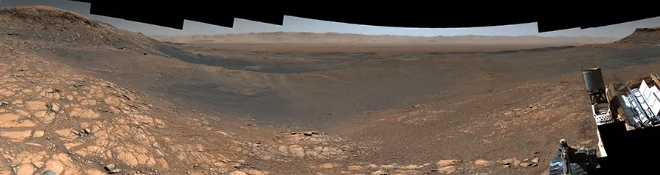
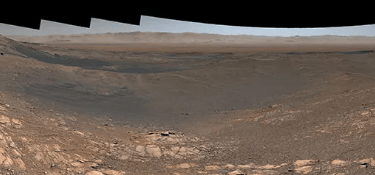
The image looks like it could be from Nevada or Utah—dry ridges, sculpted dunes, mountains faint in the distance under a pale sky. But the dust is redder, the sky thinner, and the horizon belongs to another world. This is Mars, as seen through the mechanical eyes of NASA’s Curiosity rover, which last week sent back one of the clearest panoramas in its 13-year mission.
The view is a rare one. Usually, Martian skies are choked with fine dust that blurs distant features. But a lull in storms gave Curiosity the kind of clarity that photographers dream of. The result: a sweeping mosaic of Gale Crater, stitched from hundreds of high-resolution images.
“This is as close as you can get to standing on Mars without a spacesuit,” said Jennifer Trosper, Curiosity’s project manager at NASA’s Jet Propulsion Laboratory.
A Survivor Rover
Curiosity landed in 2012, part of NASA’s most ambitious Mars mission at the time. It was expected to last two Earth years. Thirteen years later, the rover still trundles across the Martian desert, drilling rocks, tasting soil, and photographing landscapes. Its tire treads are worn, its instruments weathered, but it endures.
Gale Crater, its home, was chosen because scientists believe it once held a lake billions of years ago. Layers of sediment in its central mountain, Mount Sharp, act like pages of a Martian history book. Each panorama helps scientists piece together how Mars shifted from a wetter, warmer world into the frozen desert we see today.
The Human Connection
There’s something oddly intimate about Curiosity’s images. They remind us that Mars is not just a dot of light in the sky, but a place—real, physical, and waiting. Panoramas turn the abstract into the tangible.
“People sometimes forget the scale,” said Dr. Katie Stack Morgan, a deputy project scientist. “You can imagine yourself hiking those ridges, walking those dunes. That’s the power of these images—they turn Mars into a landscape you could inhabit.”
For a species that dreams of colonizing other worlds, Curiosity’s snapshots are postcards from the future.
Beyond Science
Of course, the panoramas serve scientific purposes: analyzing rock layers, monitoring dust storms, studying erosion. But they’ve also become cultural artifacts. Artists paint them, musicians score them, schoolchildren print them on posters. Curiosity, a robot millions of miles away, has become one of humanity’s most prolific photographers.
And in each photo lies a hint of loneliness. There are no footsteps in the sand, no birds in the sky, no sound but the whisper of thin winds. Just one tire-tracked rover, sending back views of a world waiting for its first human visitors.
Video Footage
NASA's Curiosity rover on Mars has captured a panorama of Gale Crater's rim and more from Mt. Sharp, providing us on earth with perhaps the clearest view of the planet we've ever seen. The rover "continues to climb the flanks of Mt. Sharp," according to NASA. Credit: NASA | edited by Space.com's [Steve Spaleta]

the LA Hours © 2024
Reframe your inbox
Subscribe to our newsletter and never miss a story.
We care about your data in our privacy policy.