
Rwanda Rides: How Kigali Became the Heart of Global Cycling
The 98th edition of the Road World Championships in cycling is taking place in Kigali, Rwanda (Sept 21–28). It’s the first time this elite event is hosted in Africa. The course is very challenging: lots of climbing and high altitude, which favors certain types of riders.
WORLD NEWSSPORTFEATURED
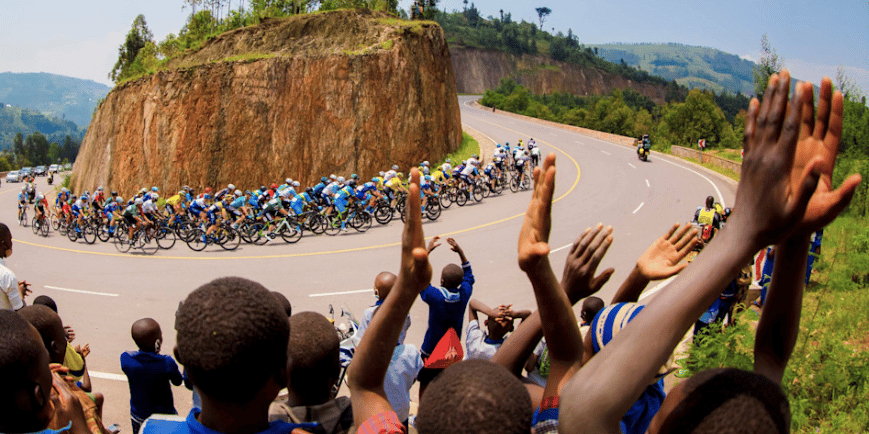
The morning air in Kigali is heavy with anticipation. On the city’s steep hills, children dangle their legs off stone walls, women in bright kitenge wraps balance baskets on their heads, and men cluster on motorbikes, all waiting. The hum grows until it becomes a roar—the whoosh of tires, the blur of jerseys, the peloton has arrived. For the first time in history, the UCI Road World Championships, cycling’s most prestigious competition, has come to Africa.
The symbolism is as weighty as the climbs themselves. Rwanda, a nation still healing from the scars of genocide just three decades ago, is now hosting an event that epitomizes endurance, unity, and global attention. For locals, it isn’t just a race. It’s a story of transformation.
The Long Ride to Kigali
Cycling may seem an odd fit for Africa’s heartland. For decades, the sport has been dominated by Europe’s cobbled classics, France’s Alps, and Italy’s Dolomites. African riders, though talented, rarely had the infrastructure or visibility to break through. That began to change in the 2000s with the rise of Team Rwanda, spearheaded by Adrien Niyonshuti, who went from pedaling a single-speed bicycle in his village to competing in the Tour de France.
Today, Kigali has become the symbol of that journey. With roads that snake like ribbons through lush green hills, the city offers a natural arena. But it also represents something bigger: Africa demanding recognition not just as a participant but as a stage for global sport.
“When I see the peloton here, I think of how far we’ve come,” says Jean Bosco Nsengimana, a Rwandan cyclist who has raced internationally. “We are no longer spectators of Europe’s races. The world is coming to us.”
A Brutal Course
The course is not for the faint of heart. Rwanda is known as the “Land of a Thousand Hills,” and riders face ascents that push lungs to their limit at elevations above 1,500 meters. Humidity soaks through jerseys; hairpin turns test nerves. Commentators are calling it one of the toughest world championship circuits in decades.
“This isn’t Paris, this isn’t Copenhagen. This is Kigali,” says UCI President David Lappartient. “It demands a new kind of rider—resilient, explosive, adaptable.” For African riders, it’s a chance to prove their mettle against the world’s best on home terrain. For global champions, it’s a humbling reminder that cycling’s geography has widened.
The Human Landscape
But the story of Kigali 2025 isn’t just about wattage and wheels. It’s about the streets lined with ordinary Rwandans, some of whom endured the horrors of 1994 and now cheer their children as flag-waving fans. For them, the sight of cyclists from more than 70 nations cresting their hills is a symbol of belonging.
Local businesses are booming. Cafés on the course serve passionfruit juice to tourists, guesthouses are full, and vendors hawk handmade bike sculptures to visitors. Kigali’s mayor has called the event “our second liberation,” a moment when Rwanda asserts itself not as a survivor but as a host.
A Global Turning Point
Sports historians argue that this championship marks a pivot in cycling’s identity. For over a century, the sport’s mythos was tied to Europe’s mountains and roads. Now, with Kigali’s hosting, it signals a new era of truly global competition.
“This is not charity, this is not symbolism—it’s merit,” says Ashley Gruber, an American photojournalist covering the race. “The course is world-class, the crowd is electric, the riders are challenged in ways they never have been. Africa isn’t being added to cycling—it is reshaping it.”
The Road Ahead
By the time the final medals are awarded, the hills of Kigali will have written their own legend. Whether or not an African rider claims gold, the victory is already shared: Rwanda has staged an event that shifts cycling’s map.
For children on Kigali’s curbs, watching Lycra-clad heroes zoom past, the seed is planted. One day, they might be the ones climbing out of these hills to take on the world.
And perhaps that is the real legacy of Kigali 2025: not the trophies, but the promise that the center of gravity in global cycling is no longer fixed in Europe, but open to wherever the road leads.
the LA Hours © 2024
Reframe your inbox
Subscribe to our newsletter and never miss a story.
We care about your data in our privacy policy.