
Swallowed Whole: Florida’s Python Problem and the Rise of the Robo-Rabbit Army
Blog post description.
WORLD NEWSFEATUREDSCIENCE

A Scene from a Swamp Horror Movie
The air is thick, wet, and humming with mosquitoes in Big Cypress National Preserve. Cypress knees rise like knobby elbows from the water, and Spanish moss hangs like ghostly curtains. A wildlife officer wades through knee-deep swamp, flashlight beam cutting through the brush.
And there it is.
Coiled and sluggish, a Burmese python thicker than a firehose unhinges its jaw and spits out… a deer. Not a rib, not a leg, not a carcass gnawed by scavengers. The whole deer. Half-digested, steaming in the night air.
“It’s the kind of thing you don’t forget,” said Mike Kirkland, who manages the South Florida Water Management District’s python program. “The smell alone… Let’s just say it wasn’t venison you’d want to grill.”
Florida’s python problem has been infamous for years, but moments like this are still shocking. Snakes that should live in the jungles of Southeast Asia are slithering through the Everglades, swallowing everything in sight — from raccoons to bobcats to deer. Biologists have even cut open pythons to find alligators inside. And they’re winning.
How Did Florida Become Snake Central?
The story starts, like many Florida tales, with human folly. Burmese pythons were first brought to the U.S. through the exotic pet trade in the 1970s and 80s. At first, they were trendy “wow factor” pets — small enough to fit in a terrarium, dramatic enough to impress neighbors.
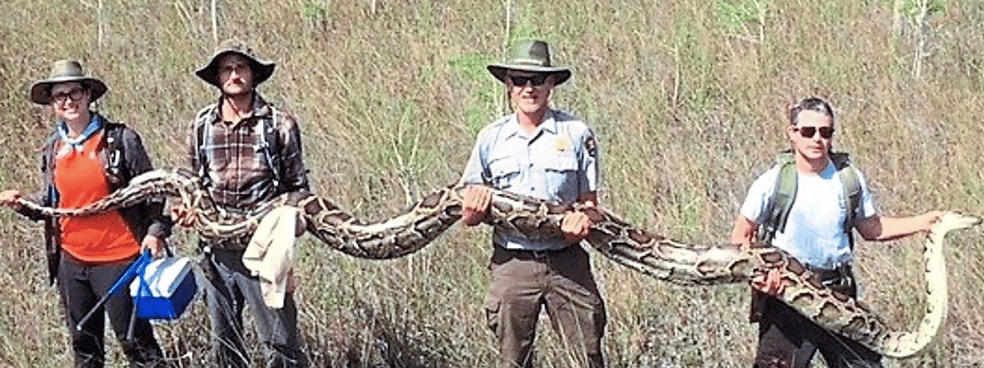
But there’s a catch: pythons don’t stay small. They grow. And grow. And grow. A hatchling snake the size of a shoelace can balloon into a 15-foot apex predator within a decade. Overwhelmed pet owners began releasing them into the wild.
Then came 1992’s Hurricane Andrew, which destroyed breeding facilities south of Miami. Thousands of snakes escaped into the Everglades. The swamp, with its warm climate and abundant prey, turned out to be python paradise.
By the early 2000s, biologists realized the snakes weren’t just surviving — they were thriving. Female Burmese pythons can lay up to 100 eggs in a single clutch. Population estimates vary, but experts say there are now tens of thousands, possibly over 100,000, slithering through South Florida.
The Ecological Wreckage
The Everglades once teemed with raccoons, rabbits, opossums, and foxes. But a 2012 study in Proceedings of the National Academy of Sciences documented catastrophic declines:
Raccoons: down 99%
Opossums: down 98%
Bobcats: down 88%
Marsh rabbits: virtually gone
Predators like alligators still exist, but they’re now in direct competition with pythons — and sometimes end up as prey themselves. Viral photos of pythons bursting open after swallowing alligators have become morbid symbols of a food chain out of balance.
“It’s an ecological war,” said Dr. Frank Mazzotti, a University of Florida wildlife biologist. “And the snakes are winning.”
Fighting Back: From Bounties to High-Tech Hunts
Florida has tried nearly everything to slow the invasion.
Python Bounty Programs: Hunters can earn $50–$200 per snake, with bonuses for size. Some dedicated python catchers have made full-time jobs out of it.
Python Challenges: Annual competitions invite the public to catch as many snakes as possible. Winners walk away with thousands of dollars and internet fame.
Tracker Snakes: Biologists fit male pythons with GPS transmitters. Nicknamed “scout snakes,” they lead hunters to breeding females, which are then removed.
Canine Units: Dogs trained to sniff out snakes have joined the fight.
But the snakes keep spreading. Which is why scientists are turning to something new: robotic prey decoys.
Enter the Robo-Rabbit
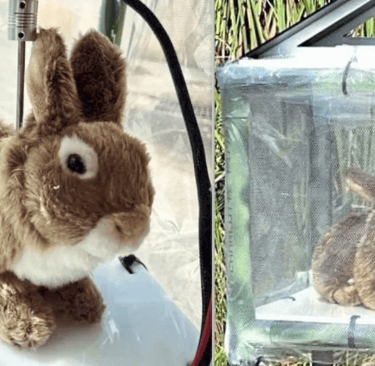
On the surface, it sounds absurd: fighting invasive pythons with robotic bunnies. But the concept is grounded in science.
Researchers noticed that pythons respond to the movements of small mammals — rabbits, rats, opossums. So engineers built decoys that mimic those motions, complete with heat signatures that fool the snakes’ infrared sensing pits.
“When you can trick a 15-foot python into thinking your rabbit is real, you’ve basically weaponized Disney animatronics,” joked Dr. Ian Bartoszek of the Conservancy of Southwest Florida.
The robo-rabbits are deployed with cameras and trackers. When a python strikes, biologists swoop in. It’s still experimental, but early trials suggest snakes can’t resist the lure.
Hunters of the Swamp
On a muggy night outside Miami, professional hunter Donna Kalil patrols levees with a spotlight. She’s one of the top bounty hunters in Florida, with over 700 snakes removed.
“You don’t sleep much when you’re out here,” she said, gripping a hook pole. “But the adrenaline keeps you going. Every time I grab one, I think: that’s one less deer, one less rabbit, one less endangered bird it’s going to eat.”
Kalil describes wrestling a 17-foot python like “wrangling a firehose that wants to kill you.” She jokes that robo-rabbits could put her out of business, but admits she’d welcome any help.
“Bring on the robots,” she laughed. “I’m not too proud to let a bunny do my work for me.”
Why Pythons Fascinate (and Horrify) Us
Part of the public’s obsession with the python saga is pure spectacle. News of snakes swallowing deer or alligators reads like pulp horror. Photos go viral. Discovery Channel churns out specials. Florida, already America’s capital of weird headlines, leans into the absurdity.
But beneath the spectacle lies a sobering reality: ecosystems can unravel when invasive species slip the leash. And the Everglades isn’t just swamp; it’s a vital wetland filtering water for millions of Floridians.
“The python isn’t just an invasive snake,” Mazzotti said. “It’s a symbol of how fragile our systems are — and how human mistakes echo for generations.”
What If We Lose?
Biologists admit total eradication is unlikely. The best-case scenario is containment — keeping pythons from spreading north into the rest of the U.S. Southeast. With climate warming, their potential range could expand alarmingly.
If unchecked, the Everglades could transform into a “green desert,” stripped of midsize mammals. That has cascading effects: fewer prey animals for panthers, altered vegetation from missing herbivores, even changed fire cycles.
The war is costly, messy, and weird. But in the swamps of Florida, it’s deadly serious.
Back to the Deer
The python that regurgitated the deer didn’t survive long after its grotesque performance. Wildlife officers removed it, logging another entry in Florida’s grim ledger of invasive giants.
But in a warehouse nearby, engineers test robo-rabbits on conveyor belts, fine-tuning hops and heat signatures. The next time a python slithers into a swamp clearing, it may face not a deer, but a decoy.
And maybe — just maybe — a future where Florida’s ecosystems get to breathe again.
Until then, the Everglades remains a battlefield. One side armed with teeth and coils, the other with spotlights, GPS trackers, and robotic bunnies.
Welcome to the weirdest war in America.
the LA Hours © 2024
Reframe your inbox
Subscribe to our newsletter and never miss a story.
We care about your data in our privacy policy.