The Medical Crystal Ball: How AI Found the Future Hidden in Your Blood
Routine blood tests analyzed by AI are revealing hidden patterns that predict recovery outcomes in spinal cord injuries.
HEALTHSCIENCEFEATURED
The Scene: A Routine Test with a Strange Twist
It starts like any other hospital visit. A patient lies on a gurney, bandaged after a devastating car accident. A nurse ties a rubber strap around his arm, finds a vein, and fills vials with blood. The labels are scanned, the samples sent to the lab. For decades, this ritual has been as ordinary as medicine gets. Blood in tubes. Machines whirring. Numbers on charts.
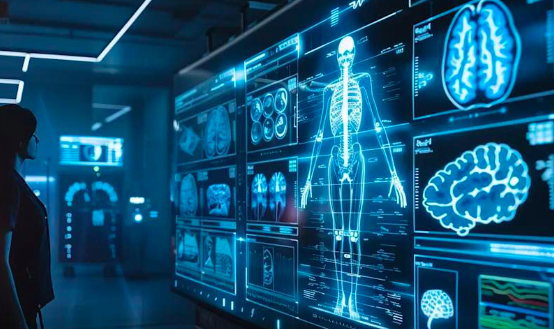
But here’s the twist: in this hospital, those vials aren’t just being checked for the usual suspects — blood counts, glucose levels, electrolytes. They’re also being fed into an algorithm, one that doesn’t just measure health now but predicts health tomorrow.
And when doctors look at the AI’s screen, it tells them something unsettlingly powerful: how well this patient will recover from a spinal cord injury, based only on subtle patterns in those blood results.
“This is like fortune-telling, except it’s backed by statistics,” says Dr. Maria Gomez, a neurologist at the University of Toronto who worked on the study. “The algorithm picks up things our human eyes can’t.”
From Crystal Balls to Code
The desire to predict health outcomes isn’t new. Ancient Chinese doctors studied pulses. Medieval physicians read urine like tea leaves. In the 19th century, European doctors carried ornate charts claiming to predict disease from facial structure. Much of it was pseudoscience — comforting rituals with no grounding in biology.
What’s different now is the math.
Modern blood panels produce dozens of data points: proteins, enzymes, counts of different blood cells. On their own, these numbers flag obvious red alerts: high cholesterol, low hemoglobin. But AI — particularly machine learning — thrives on patterns invisible to the human mind. It can weave together dozens, even hundreds, of faint signals into a cohesive forecast.
“We’re not inventing new tests,” Gomez explains. “We’re reinterpreting the ones we’ve had for years.”
The Spinal Cord Injury Breakthrough
The recent study focused on one of medicine’s most devastating conditions: spinal cord injuries. Recovery can vary wildly. Some patients regain partial function. Others remain paralyzed. For doctors, predicting outcomes is notoriously difficult.
So researchers fed routine blood test data from hundreds of patients into a machine-learning algorithm. They told the AI: these patients recovered to this extent, these patients didn’t. Find the patterns.
The result: a model that could predict recovery trajectories with striking accuracy, based purely on blood chemistry. The key wasn’t a single magic marker but a constellation of subtle imbalances — immune responses, protein ratios, inflammation signals — that together formed a fingerprint of resilience or decline.
“It’s like listening to an orchestra,” Gomez says. “Doctors hear the violins, maybe the horns. The AI hears the entire symphony.”
Why Blood?
Blood is our body’s gossip columnist. Everything spills into it: immune fights, hormone whispers, organ distress. When you’re sick, your blood knows before you do. But the signals are often faint, buried under noise.
Machine learning doesn’t get bored. It can sift through millions of data points and find recurring whispers. “In many ways, blood is the ultimate dataset,” says Dr. Kevin Liang, a data scientist not involved in the study. “We’ve just been underutilizing it.”
From Fortune Teller to Doctor’s Assistant
Doctors aren’t thrilled about being compared to fortune tellers. But the metaphor isn’t far off. AI predictions don’t provide certainty — they provide probabilities. A patient might have an 80% chance of regaining walking ability, or a 40% chance of needing permanent assistance.
For patients and families, those numbers matter. They shape rehab plans, resource allocation, even emotional preparation.
Still, some doctors are cautious. “We don’t want families to lose hope based on an algorithm,” warns Dr. Emily Reed, a rehabilitation specialist. “People defy predictions all the time. But as a guide, this is incredibly powerful.”
The Promise and the Pitfalls
Like all AI in medicine, blood-based predictions come with both promise and peril.
The Promise:
Faster decision-making in emergencies.
Tailored rehabilitation programs.
Better allocation of medical resources.
The Pitfalls:
Bias: If the training data skews toward certain demographics, predictions may be less accurate for underrepresented groups.
Overreliance: Doctors might defer too much to the algorithm.
Privacy: Blood tests contain intensely personal data. Who owns the algorithm’s insights?
“It’s a double-edged sword,” Liang admits. “AI can democratize insight — or deepen inequalities if we’re not careful.”
Blood as the Next Health Dashboard
Imagine a future where your annual checkup doesn’t just tell you cholesterol levels but forecasts your risk of developing Alzheimer’s in 15 years, or predicts how well you’d recover from surgery.
Some startups are already working on it. Companies like GRAIL and Guardant Health analyze blood for early cancer signals. Others use proteomics — large-scale protein analysis — to create “health fingerprints.”
The spinal cord injury study is just the beginning. Researchers are asking: Could AI blood models predict who’ll respond best to antidepressants? Who will recover fastest after a heart attack? Which athletes are most likely to tear a ligament?
“If blood holds the future,” Reed says, “AI might be the key to reading it.”
The Human Side of Prediction
Back in Toronto, one patient who joined the study, 29-year-old Miguel R., recalls the mix of dread and hope when doctors explained the AI predictions.
“They told me, ‘the algorithm suggests you’ll recover partial mobility.’ At first, it felt like a sentence,” Miguel says. “But then I realized it meant there was a path. It gave me something to aim for.”
Months later, Miguel is walking short distances with assistance. “The AI wasn’t perfect,” he laughs. “But it was right enough to keep me motivated.”
Snark, Skepticism, and the Crystal Ball Vibe
Not everyone’s impressed. Critics call AI medical predictions “fancy horoscopes.” And the tech’s mystique doesn’t help — most people don’t understand how machine learning works, only that it spits out answers.
“Patients sometimes ask if the AI can tell them when they’ll die,” Reed says dryly. “No, it can’t. Not yet.”
Still, the crystal ball analogy sticks. Instead of palm lines or tarot cards, doctors are staring at probability curves and biomarker maps. Instead of fortune tellers whispering “I see your future,” algorithms churn out recovery odds.
The weird part? This time, it’s real.
The Bigger Picture
The AI-blood study highlights a shift in medicine: from reactive to predictive. For centuries, doctors treated illnesses after symptoms appeared. Now, we’re inching toward a model where blood, analyzed by AI, warns us before we fall sick, or forecasts recovery before rehab begins.
It’s not flawless. It may never be. But it changes the relationship between patients and time. Medicine, once locked in the present, is starting to peek into the future.
Final Thoughts: The Future is in the Vial
Back in Sandyktau, firefighters stumbled on a stone face staring at them across centuries. In Toronto, doctors stumbled on another kind of face: a reflection of tomorrow hidden in today’s blood. Both discoveries remind us that sometimes, the most extraordinary things are hiding in plain sight.
For patients like Miguel, the vial isn’t just a test. It’s a glimpse into tomorrow.
And maybe, just maybe, the future of medicine looks less like a doctor with a stethoscope and more like a machine whispering, in the quiet hum of data, “Here’s what comes next.”
the LA Hours © 2024
Reframe your inbox
Subscribe to our newsletter and never miss a story.
We care about your data in our privacy policy.