
The Physics of Pasta: How Scientists Solved Cacio e Pepe
Physicists won an Ig Nobel for uncovering the exact conditions (temperature, starch concentration, etc.) needed to get that creamy sauce texture in cacio e pepe—cheese, pepper, pasta.
CULTUREHEALTHSCIENCE
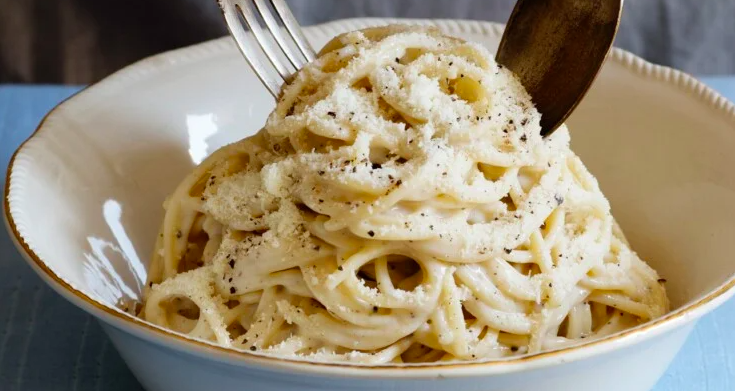

On a rainy September afternoon in Stockholm, as the world’s serious-minded Nobel committees prepared to crown advances in medicine, physics, and chemistry, a different kind of award ceremony drew laughter from a packed lecture hall. Researchers were being honored for discoveries that make people “laugh, then think.” The Ig Nobel Prize, as always, was in fine form.
Among this year’s winners: a group of physicists who cracked the culinary conundrum of one of Italy’s most beloved dishes: cacio e pepe.
For centuries, Roman grandmothers and Michelin-starred chefs alike have insisted that the creamy sauce of cacio e pepe—a luscious blend of pasta, pecorino cheese, and black pepper—depends on intuition. Too much heat and the cheese clumps. Too little starch and the sauce separates. The difference between creamy heaven and a cheesy disaster often seemed like magic.
Now, thanks to a team of Italian physicists, we know it’s not magic at all. It’s thermodynamics.
The Mystery of the Sauce
To the untrained eye, cacio e pepe looks simple. Pasta water, grated pecorino Romano cheese, pepper. Stir until creamy. But anyone who has tried to make it at home knows heartbreak lurks in the pot.
The cheese either refuses to emulsify, clumping into rubbery lumps, or it turns into an oily slick that slides off the noodles. For chefs, this delicate balance has been passed down as wisdom: “Add cheese off the heat, whisk furiously, trust your instinct.”
But physicists saw an unsolved problem. “Food is chemistry, and chemistry is physics in action,” said Dr. Marco Antonelli, one of the prize-winning researchers. “If Roman grandmothers can do it perfectly every time, then surely physics can explain why.”
Into the Lab: Cheese Meets Science
The team recreated the dish in a lab environment, treating pasta water as a colloidal suspension—a mixture where particles (starch molecules) are suspended in liquid. Cheese, rich in proteins and fats, must integrate into this suspension without separating.
Using microscopes, rheology instruments, and temperature-controlled environments, the physicists mapped the precise window in which the sauce holds together.
Their conclusion:
Temperature matters. The sauce works best between 82–85°C. Hotter, and proteins seize up into clumps. Cooler, and the fat refuses to melt properly.
Starch is the secret stabilizer. As pasta cooks, it releases starch into the water. This starch coats proteins in the cheese, keeping them suspended and preventing them from sticking together. Too much starch and the sauce thickens to paste; too little and it collapses.
Agitation is key. Constant whisking isn’t just tradition; it disperses proteins evenly, preventing localized clumping.
In short: cacio e pepe succeeds not by accident but by a precise alignment of physics.
Why It Matters (Beyond Dinner)
On the surface, this may seem like science indulging in dinner-party trivia. But the implications ripple far beyond kitchens.
Food science intersects with materials science, chemistry, and even medicine. The principles that govern emulsification in a pasta dish are the same that guide the creation of drug delivery systems, industrial paints, and cosmetics.
“Understanding how proteins and fats interact in complex systems is vital,” said Antonelli. “If we can control a sauce, we can also design better pharmaceuticals or sustainable foods.”
Indeed, the Ig Nobel exists precisely to highlight this point: that what seems silly often conceals serious applications.
Italy Reacts: Pride and Laughter
In Rome, where culinary tradition is guarded with near-religious fervor, the announcement drew both amusement and applause. One Italian newspaper ran the headline: “Science Explains What Nonna Already Knew.”
Roman chefs, too, chimed in. “I could have told them the temperature,” laughed Chef Giorgio Bianchi, who runs a trattoria near the Colosseum. “But if they want to spend years in a lab proving it, va bene. Now maybe people will finally stop ruining my dish.”
Still, some purists grumbled. “You don’t reduce tradition to numbers,” said one chef, wagging his wooden spoon. “Food is about feel, about love, not thermometers.”
The Spirit of the Ig Nobels
The Ig Nobel Prize thrives on this tension between the absurd and the profound. Founded in 1991, the award honors real research that seems ridiculous at first glance but sparks deeper reflection. Past winners have studied why wombats’ feces are cube-shaped, how to use magnets to levitate frogs, and whether cat ownership influences human decision-making.
This year’s pasta prize fits perfectly. It makes us laugh at the image of lab-coated scientists stirring bowls of noodles under microscopes. Then it makes us think: what else can we learn when we take everyday mysteries seriously?
Back to the Kitchen
The next time you attempt cacio e pepe, you may find yourself acting like a physicist without knowing it: testing starch levels, gauging heat, whisking with purpose.
For Antonelli, that’s the ultimate victory. “We’re not here to replace Nonna,” he said. “We’re here to explain her genius—and make sure her secrets can be shared with the world.”
So the next time your sauce breaks, don’t despair. You’re not a bad cook; you’re simply battling the laws of thermodynamics. And now, thanks to science, you know how to win.
the LA Hours © 2024
Reframe your inbox
Subscribe to our newsletter and never miss a story.
We care about your data in our privacy policy.