
Tumor Head: The Man Who Lived with a Pillow on His Neck
How one Russian pensioner carried a fifteen-pound tumor for sixteen years — and what it says about our strange comfort with discomfort.
WORLD NEWSHEALTHFEATURED

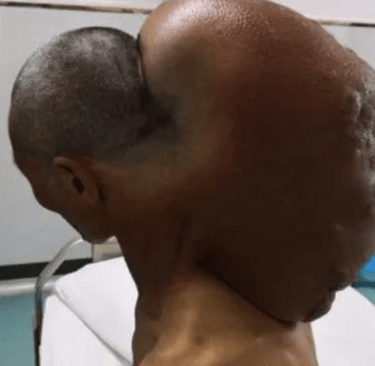
In a world addicted to optimization, self-improvement, and wellness hacks promising abs by next Tuesday, a sixty-five-year-old man in rural Russia lived for sixteen years with a tumor the size of a small pillow attached to his neck — and did almost nothing about it.
He wasn’t lazy. He wasn’t ignorant. He was, in his words, “busy.” Busy living, busy enduring, busy not dying — which, in the end, is the same thing most of us are doing, just with fewer visible lumps.
According to Russian medical reports, the man (whose name was mercifully withheld) finally sought help after the lipoma — a benign fatty tumor — grew so large that sleeping flat became impossible. “I propped my head on it,” he told doctors, as though describing a travel pillow. Surgeons removed the growth in a single operation, a procedure that generated headlines mostly because of how long he’d tolerated it. But buried under the grotesque detail was a strangely profound story about denial, adaptation, and the sheer human ability to normalize anything, given enough time.
Because really, who among us isn’t walking around with some kind of metaphorical tumor?
The Quiet Monster
The photos — which you shouldn’t look up over breakfast — show a man whose neck bulges outward like a swollen balloon. It’s soft, rounded, not malignant or monstrous in the cinematic sense. Just there. Lurking in plain sight, tolerated the way we tolerate slow internet or chronic back pain or governments that barely function.
Lipomas are almost always benign. They’re soft, movable lumps of fat that grow between skin and muscle tissue, rarely painful and sometimes hereditary. Most people, upon finding one, get it checked, maybe removed. But for this man, it became background noise — the body’s version of a squeaky ceiling fan you promise to fix someday.
“I thought it would go away,” he said in a TV interview after surgery. “It was not dangerous, so I let it live.” The phrasing — let it live — struck a chord with viewers. There was a strange empathy in it. He’d anthropomorphized the thing, almost befriended it. A relationship built on resignation and quiet coexistence.
That’s the part that lingers: the sense that he wasn’t suffering so much as managing. Because he could. Because it was easier to adapt than to act. The human body — and mind — can adjust to almost anything, especially discomfort that grows slowly enough to trick us into thinking it’s normal.
A Lesson in Incrementalism
If the tumor had sprouted overnight, he’d have sprinted to a doctor. But it didn’t. It took sixteen years, expanding cell by cell, too slowly to provoke panic. He lived his entire 50s in a gradual negotiation with it — adjusting shirt collars, sleeping angles, maybe his self-image. A slow creep of inconvenience that became identity.
It’s easy to scoff until you realize that incremental surrender is one of humanity’s defining features. The climate crisis, political extremism, social media addiction — none of them exploded overnight. They metastasized through the same psychological loophole: “It’s not that bad yet.”
We are masters of “yet.”
Yet is the word that keeps you scrolling instead of sleeping, staying instead of leaving, tolerating instead of changing.
Yet is the tumor whispering, maybe tomorrow.
The Aesthetics of Tolerance
If there’s something distinctly Russian about this story, it’s the stoicism. This is, after all, a nation that endured subzero winters, decades of shortages, and government paperwork that could make a saint swear. The cultural script rewards endurance, not complaint.
But look closer, and it’s not uniquely Russian at all. There’s a universality in the decision to bear what could be fixed. Americans do it too — only with mental tumors instead of physical ones. Depression untreated because therapy costs too much or feels weak. Relationships decaying out of inertia. Entire cities built around convenience rather than community, growing metaphorical fat in all the wrong places.
We live with lumps of all kinds: invisible, quiet, embarrassingly manageable.
When “Normal” Is Just Slow Disaster
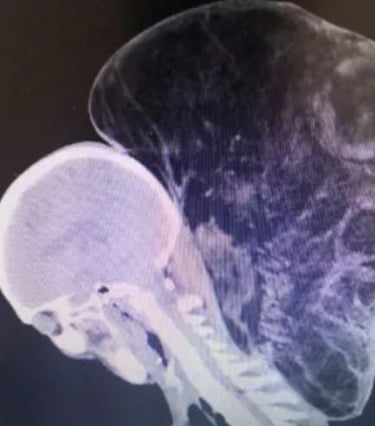
Medical experts who examined the case noted that lipomas can reach enormous sizes when left unchecked. The body doesn’t see them as threats, so the immune system shrugs. The man’s was roughly the size of a basketball, weighing nearly fifteen pounds. It had its own blood vessels — a freeloading roommate metabolically tethered to him.
It’s grotesque and weirdly relatable.
Because in truth, many of us walk around feeding our own benign burdens: jobs that drain us but pay the rent; friendships that exist only out of habit; habits that feel like identities.
The longer we let them grow, the less we remember what “without it” feels like.
The Surgery
When surgeons finally excised the mass, the man wept — not from pain but relief. “It’s strange,” he said afterward. “I feel lighter but also… different. I got used to it.”
Doctors said the operation was routine; the headlines, however, were not. “Man Carries Tumor for 16 Years” sounds absurd until you strip away the medical context and realize that’s just… life. We all carry something for 16 years — guilt, resentment, a bad back, a high-interest loan — until one day the removal feels both liberating and oddly incomplete.
Because once you’ve shared space with a problem for long enough, it starts to define you.
The Aftermath
Russian social media users nicknamed him Tumor Head, which is cruel but predictably internet. Others applauded him for surviving so long without complaint. One comment read: “He is stronger than me; I complain when my Wi-Fi drops.”
Some journalists asked whether the tumor changed his personality. He said no — though one imagines sixteen years of physical imbalance might shape your sense of self. Imagine the posture adjustments, the stares, the conversations that begin and end with “What happened to your neck?” You don’t just remove the weight; you remove the story.
The doctors disposed of the lipoma, incinerated like medical waste. But symbolically, it feels like a tiny act of existential spring cleaning — throwing out a decade of complacency in one decisive cut.
The Tumor as Metaphor
Maybe that’s why the story stuck. Because the tumor isn’t really the tumor. It’s the thing we live with because it’s easier than fixing it. It’s your cluttered inbox, your unsaid apology, your unpaid parking ticket. It’s the slow rot of habits accumulating under the banner of “I’ll deal with it later.”
In an age obsessed with optimization, this man is an accidental prophet of imperfection. A reminder that adaptation, though admirable, can also be a trap. You can survive almost anything if it grows slowly enough — but survival isn’t the same as health.
He lived sixteen years with his burden because it didn’t hurt enough to act. That’s the real horror story. Not the tumor itself, but how long we can endure being slightly miserable.
The Moral (Such as It Is)
When asked why he finally went to the doctor, he said simply: “It got in the way of sleeping.”
Of course it did. That’s how all change begins — not with a moral awakening, but with inconvenience. The world doesn’t reform because it should, but because something finally interrupts our comfort. A pillow too heavy, a neck too tired, a metaphor too on the nose.
And then, one day, after years of quiet tolerance, the knife comes down — literal or figurative — and you remember what lightness feels like.
the LA Hours © 2024
Reframe your inbox
Subscribe to our newsletter and never miss a story.
We care about your data in our privacy policy.